Three Days in New York City, Hour by Hour
Three days covers Lower Manhattan and the harbor, a full Midtown day on foot, and the Met with Central Park. You walk 20 to 21 kilometers in total. What you give up is the Bronx, Queens, a second observation deck, and any real time in Brooklyn beyond one evening in DUMBO.
The three days at a glance
Each day runs in one direction. Nothing doubles back, no day contains two observation decks, and no day needs the subway more than twice. Day two does not need it at all.
- Day 1 · Lower Manhattan, the harbor and one river crossingAbout 8 km, or 5 miles.
- Day 2 · Midtown end to end, without a single subway rideAbout 5 km, or 3 miles, all of it flat.
- Day 3 · The Met, Central Park and the long walk southAbout 7 km with the High Line closer and 8 with the Village one, so 4.3 to 5 miles. Central Park is the single biggest stretch of it.
How this plan was built
The shape of it, downtown then Midtown then uptown, is the same order our published New York City guide and Manhattan guide already recommend. What this page adds is the clock, the distances and the subway lines, so you can see whether a day is actually possible before you are standing in it.
Walking times are distance divided by 5 km per hour, rounded to the nearest minute, which is a normal city pace including crossings. Nobody timed them with a stopwatch and we are not going to pretend otherwise. Where a stretch is deliberately slower, the bridge, the park and the High Line, we say so and give the strolling number instead. Distances come from the geometry of the Manhattan grid, where 20 north to south blocks make a mile and a crosstown block runs 230 to 280 meters. Subway times exclude waiting for the train, so add 5 to 10 minutes per ride, and check any specific journey on the MTA trip planner, which also publishes the weekend track work that is the single most common reason a plan like this bends.
Durations for each attraction come from the same dated entries that power our New York glossary, and every place named below links to its own entry with sources. There are no admission prices, fares or opening times anywhere on this page. Those change, and the official sources for each one are named at the bottom.
The plan, day by day
Morning, afternoon and night, with the clock times we would actually use. The times are a skeleton rather than a schedule. The order is the part that matters, because it is what stops you crossing the same river or the same avenue twice in a day.
Day 1.Lower Manhattan, the harbor and one river crossing
South to the water, north to the World Trade Center, east over the bridge. One direction all day, and you cross the East River once, on foot, with the skyline behind you and dinner on the other side.
- Distance on foot
About 8 km, or 5 miles.
- Where it comes from
4.3 km on the legs named below: 1 km from Battery Park to the World Trade Center, 1.1 km on to the bridge entrance, 1.8 km across the bridge and 0.4 km down to Washington Street.
- And the rest
Another 3.7 km of ground you cover without going anywhere: Battery Park and the ferry terminal, the loop around the World Trade Center and the Oculus, DUMBO's streets, and Pier 1 and back. Museum interiors are on top of all of it.
- Subway rides
One subway ride down in the morning, one ferry or subway back at night.
Morning 08:30 to 12:30Battery Park, Liberty Island and Ellis Island
Take the earliest ferry slot you were able to book. Only the official operator lands on the islands, it leaves from Battery Park, and the full loop from security queue to return dock runs 3 to 4 hours. Everything else today is flexible. This is not.
Do the statue first, then give Ellis Island the longer half. The searchable passenger manifests are the reason people stay longer than they planned, and it is the stop visitors consistently under-budget. Two unhurried hours there is not too much.
The sellers working the paths near the ferry queue with unofficial boats do not land on either island. Walk past them.
- Getting there
1 to South Ferry, 4 or 5 to Bowling Green, or R or W to Whitehall Street. All three leave you within 5 minutes of the queue.
- Time on the ground
3 to 4 hours door to door, security and both islands included.
- If you skip it
The free Staten Island Ferry passes close enough for photographs and takes 25 minutes each way. It buys back the whole morning.
Afternoon 12:45 to 16:00The World Trade Center site
Walk north from Battery Park along Greenwich Street. It is about 1 km, so 12 minutes, and it puts you at the 9/11 Memorial pools without touching the subway. The pools sit in the footprints of the towers, they are outdoors and free, and 20 minutes is enough.
Eat before you go underground, not after. The Oculus and Fulton Street are 2 minutes away and the museum below takes 2 to 3 hours and lands heavily. Plan something gentle after it, which is exactly what the rest of this day is.
Deciding between the pools alone and the pools plus the museum is the real fork in the afternoon. Both are respectable. The museum costs you the relaxed version of the Brooklyn Bridge crossing.
- On foot
1 km from Battery Park, about 12 minutes up Greenwich Street.
- Time
20 minutes for the pools. Add 2 to 3 hours for the museum, plus lunch.
- Book
Timed entry for the museum, online, days ahead. The outdoor pools need nothing.
Late afternoon 16:00 to 17:15Walking the Brooklyn Bridge
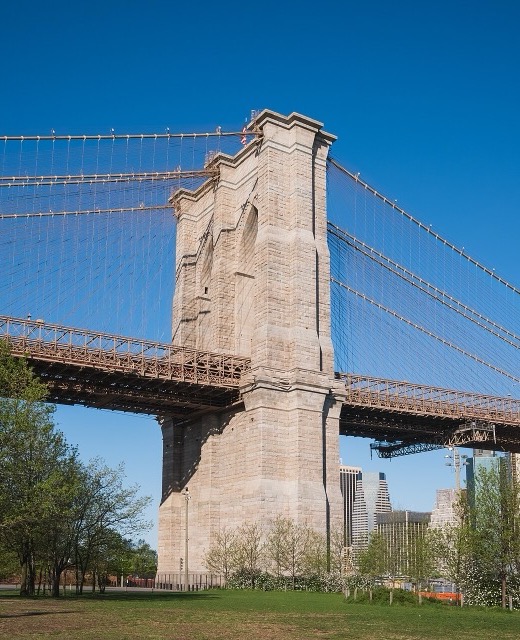
The Manhattan entrance to the Brooklyn Bridge walkway is on Centre Street opposite City Hall Park, 1.1 km and about 13 minutes from the memorial. The crossing itself is 1.8 km and takes 30 to 45 minutes at photograph speed. Cyclists have their own lane down on the roadway now, so the promenade is calmer than its reputation.
Purists will tell you to ride the subway to Brooklyn and walk back toward Manhattan so the skyline is in front of you the whole way. They are right about the view and wrong about the day. Walking east in late afternoon puts the sun behind you, delivers you into Brooklyn for dinner, and lets the city light up while you are on the water. Reverse it only if the photograph matters more than the evening.
- On foot
1.1 km to the entrance, then 1.8 km across. Budget 45 to 60 minutes for both.
- Best window
Late afternoon eastbound, or sunrise westbound. Midday is the one to avoid.
- Cost
Free, and no booking of any kind.
Night 17:15 onwardDUMBO, the waterfront and the way home
You come off the bridge above DUMBO. Washington Street, where the Manhattan Bridge frames the Empire State Building, is 5 minutes downhill and it is the one photograph everybody takes. Then drop into Brooklyn Bridge Park and walk out to Pier 1, which is the sunset spot: bridge, skyline and harbor in one frame.
Eat in DUMBO or up the hill in Brooklyn Heights. Go home on the East River ferry from Fulton Ferry Landing, which is one stop on the East River route and doubles as a night skyline cruise, or take the A or C from High Street if the wind has won.
- Time
A golden hour is the right unit here, so 90 minutes.
- Getting back
East River ferry from Fulton Ferry Landing, or the A or C from High Street.
- Fares
The ferry and the subway are separate systems with separate fares. Check current fares on the MTA and NYC Ferry sites.
Day 2.Midtown end to end, without a single subway ride
A straight climb from 42nd Street to 53rd and back down to 45th. Everything today is within a 15 minute walk of everything else, which is why this is the day to fill with things that take time.
- Distance on foot
About 5 km, or 3 miles, all of it flat.
- Where it comes from
2.9 km on the legs named below: 0.6 km to Bryant Park, 1 km on to MoMA, 0.5 km back down to Rockefeller Center and 0.8 km west to Times Square.
- And the rest
Another 2 km inside the buildings and around them: the concourse, the reading room, the MoMA floors, the Rockefeller plaza loop past St Patrick's and Radio City, and the walk to your seat.
- Subway rides
Zero. Day two is the day you do not go underground.
Morning 09:00 to 13:00Grand Central, Bryant Park and MoMA
Start inside Grand Central Terminal at 09:00. The main concourse, the backwards zodiac ceiling and the whispering gallery outside the Oyster Bar are a 30 minute stop and the novelty genuinely fades after that.
Walk west on 42nd Street to Bryant Park, 0.6 km and about 7 minutes. Give it 40 minutes, most of them inside the library at its back, in the Rose Main Reading Room. It is free and it is the best room in Midtown.
Then north to MoMA, 1 km and about 12 minutes up Fifth or Madison to 53rd Street. Go straight to the fifth floor before the tour groups build, then work down. Two focused hours covers the collection highlights, and a special exhibition adds an hour.
- On foot
0.6 km Grand Central to Bryant Park, then 1 km to MoMA. About 19 minutes of walking in total.
- Time
30 minutes, then 40 minutes, then 2 hours. Lunch at 13:00.
- Book
Timed entry for MoMA, online. The other two are free and need nothing.
Afternoon 14:15 to 16:00Rockefeller Center and Fifth Avenue
Rockefeller Center is 0.5 km back south from MoMA, about 6 minutes. The plaza, the gold Prometheus, St Patrick's Cathedral across Fifth Avenue and Radio City Music Hall on Sixth are a 75 minute loop on foot, and in winter the rink and the tree make it the busiest 75 minutes of your trip.
This is deliberately loose time. It is the buffer that absorbs a long lunch, a bookshop or a museum that ran over, and every workable three day plan needs one.
- On foot
0.5 km from MoMA, about 6 minutes.
- Time
75 minutes, and it stretches or shrinks without damage.
- Cost
Free to walk. The cathedral and the plaza cost nothing.
Late afternoon 16:00 to 17:30One observation deck, and only one
Top of the Rock is in the same complex you are already standing in, which is why it is the deck this plan picks. It faces the Empire State Building squarely to the south and looks straight up Central Park to the north, the two shots people actually want, and its tiered open air levels take about 90 minutes.
Book a late afternoon slot rather than the exact sunset slot. Sunset sells out first, and arriving 45 minutes before it gives you daylight, sunset and the lights coming on in a single visit, which is three views for one entry.
The alternatives, if you would rather: SUMMIT One Vanderbilt connects directly to Grand Central, so it moves to this morning instead. Edge at Hudson Yards belongs to a High Line day, which is the day three variant below. And the Empire State Building has the structural problem that from up there, it is not in your photograph.
- On foot
Zero. You are already in the building.
- Time
90 minutes including the queue and the lifts.
- Book
Timed slot, online, ahead. Compare the four decks first in our Edge versus Summit versus Top of the Rock comparison, or see what is bookable on the observation decks page.
Night 18:00 onwardTimes Square after dark, then a show
Times Square is 0.8 km and 10 minutes west, and it works exactly once, after dark, briefly, on your way to somewhere else. Fifteen minutes. The costumed characters work for tips and can be declined firmly.
Eat before the show, not after. Tables in the Theater District turn fast in the early evening and crawl once the curtains come down, and a Broadway show runs about two and a half hours with an intermission. If you have not booked a show, the discount booth under the red steps sells same day seats, and the show's own site is where you check what is playing and what a seat costs.
- On foot
0.8 km from Rockefeller Center, about 10 minutes.
- Time
15 minutes in the square, then dinner, then about 2.5 hours of theater.
- Book
A specific show on a specific night, weeks ahead. See our Broadway guide for how the seats work.
Day 3.The Met, Central Park and the long walk south
Start at the top of the map and descend. One ride up in the morning, one ride down in the late afternoon, and the middle of the day is a park you walk through rather than to.
- Distance on foot
About 7 km with the High Line closer and 8 with the Village one, so 4.3 to 5 miles. Central Park is the single biggest stretch of it.
- Where it comes from
4.1 km on the legs named below: 0.6 km from 86th Street to the Met, then 3.5 km south through the park to 59th Street.
- And the rest
Another 2.8 to 3.8 km, and this is the one place the two versions of the day genuinely differ. The Village closer is 0.8 km from Union Square to Washington Square, 1.5 km of wandering and 1.5 km east to dinner, so 3.8. The High Line closer is 0.5 km to Gansevoort Street and 2.3 km on the viaduct, so 2.8. A kilometer of difference, landing at the end of the longest day.
- Subway rides
Two. One north after breakfast, one south after the park.
Morning 09:30 to 12:30The Metropolitan Museum of Art
Take the 4, 5 or 6 to 86th Street and walk 0.6 km west, about 7 minutes, or the 6 to 77th Street and walk north and west. Watch the difference between local and express trains while you are at it, because the 4 and 5 run express where the 6 runs local on the same avenue, and sailing past your stop is the classic first morning error.
The Met is not a museum you finish. Pick two or three wings, give it three hours and accept defeat gracefully. The Temple of Dendur and the European paintings galleries are the standard first pass, and weekday mornings are the calm ones.
If art is not why you came, the American Museum of Natural History faces it across the park and carries a mixed group better. Do not attempt both. They are three hours each and they are not next door in any useful sense.
- Getting there
4, 5 or 6 to 86th Street, then 0.6 km west. About 20 to 25 minutes from Midtown with the walk at both ends.
- Time
3 hours for two or three wings.
- Book
Not usually needed, but check the museum's own site the week you travel.
Afternoon 12:45 to 15:00Walking south through Central Park
Come out of the Met onto Fifth Avenue and cross straight into Central Park. This is the whole reason the museum goes here and not somewhere else in the plan. Walking south past the Great Lawn, down through the Ramble, over Bow Bridge, across Bethesda Terrace and along the Mall to Grand Army Plaza at 59th Street is about 3.5 km and takes 90 minutes with stops.
Every lake, hill and vista in it was designed, which is the joke of the place. Eat somewhere along the way rather than sitting down properly, because the walk is the meal.
- On foot
3.5 km from the Met to 59th Street. 90 minutes at a stopping pace.
- Tired legs
A pedicab covers the southern loop without the miles. Listed in the tours below.
- Cost
Free, and no booking.
Late afternoon 15:30 to 18:00One ride south, then pick a side
Two closers, and they are genuinely different trips. The Village version: take the N, R or W, or the 4, 5 or 6, down to Union Square, walk to Washington Square Park for the chess tables and the piano under the arch, then get purposefully lost in Greenwich Village west of Sixth Avenue. About two hours.
The west side version: take the A, C or E to 14th Street and walk the High Line from its Gansevoort Street entrance north to Hudson Yards. It is 2.3 km and 90 minutes, it passes the Whitney at its southern foot and Little Island just off it in the river, and it ends at the base of Edge if you would rather have your one deck here than yesterday.
- Getting there
About 10 minutes on the train from 59th Street, so 25 door to door with the walk at both ends.
- Time
2 hours for the Village, 90 minutes for the High Line.
- Do not do both
They are on opposite sides of Manhattan and pairing them is the day three version of crossing the city twice.
Night 18:00 onwardDinner in the East Village
Whichever side you picked, end in the East Village. Walk St Marks Place east toward Avenue A and follow whatever looks busy. It is the best neighborhood in Manhattan for an unplanned night, the food is cheaper than anywhere you have eaten so far, and it is a short walk or one stop from both closers.
Leave the last evening loose on purpose. Three days of timed entries earns one night without a plan.
- On foot
About 1.5 km from Washington Square, so 18 minutes, or the L two stops east from Union Square to First Avenue.
- Time
As long as you like. Nothing after this is booked.
- Cost
Walk-in territory. Reservations are for the famous handful, not for a Tuesday.
What to book before you fly, and what to leave alone
This is the decision that saves or costs the most money on a three day trip, and it is not the one people worry about. Booking too little loses you a morning. Booking too much loses you the trip. Six things are worth locking down and the rest are actively better left open.
Book ahead, in this order
- The harbor ferry
- Weeks ahead, and months if you want crown access. One operator lands on the islands and the constraint is availability, not price. Book on the official operator's site.
- A specific Broadway show on a specific night
- Weeks ahead. Same day discount seats exist and are a real option, but they are a lottery about which show, not about whether.
- The Tenement Museum
- Days ahead. Entry is by guided tour only, capacity is small and popular slots go first. There is no walk-up version of this one.
- The 9/11 Memorial Museum
- Days ahead, timed entry. The outdoor pools above it need nothing at all.
- Your one observation deck
- Days ahead, and pick the slot before sunset rather than sunset itself. Sunset is the first thing to sell out and it is the worse value of the two.
- A food tour, if you want one
- Days ahead. Small groups, and the good ones fill.
Do not book
- Anything to do with the subway
- There is nothing to buy. OMNY means tapping the same contactless card, phone or watch at every turnstile, and fare capping handles the rest by itself after enough rides in a week. One card or device per rider, or the capping and the transfers tangle.
- The free half of this itinerary
- The Brooklyn Bridge, the High Line, Central Park, Bryant Park, Washington Square, Grand Central, the memorial pools and the Staten Island Ferry are all walk-up and all free. That is most of three days.
- A sightseeing pass, before you have made the list
- Passes win when you name four or five paid entries in advance and they are on the list. They lose when you buy first and plan afterward, which is the usual order. Write your list, then do the arithmetic on the pass operator's own site. Our passes compared explains what each one covers before you get that far.
- A hop-on hop-off bus, before you know your route
- It makes sense for the day you cover distance and no sense for the two days you walk a neighborhood. Decide after you have fixed the route, not before, and read the bus against a walking tour while you decide.
- Restaurants, mostly
- Outside a famous handful, New York runs on walking in. Booking three dinners in advance is how a trip stops being a holiday.
We publish no admission prices anywhere on this page. Where you need a number, the official source is named in where to check the numbers at the bottom.
Five versions of the same three days
The order above is built for a first visit in reasonable weather with adults. Change one of those three conditions and the plan changes with it, usually by swapping a block rather than rewriting a day.
-
If it rains
Swap the order, do not cancel anything. Move the harbor morning to whichever day looks clearest and pull the Met forward into the gap, because it is three indoor hours that were going to happen anyway. Grand Central, the library reading room, the Oculus and Chelsea Market are all indoors, all free and all on the route you were walking. Our museum guide picks the right one by situation, including for a wet afternoon in Midtown, and the best time to visit covers which months make this a real risk.
-
If you are traveling with children
One museum a day, not two, and make it the American Museum of Natural History instead of the Met. Take the ferry rather than walking the Brooklyn Bridge, or walk it in the DUMBO to Manhattan direction, which is downhill from the Brooklyn side. Use a pedicab for the Central Park stretch on day three, keep the observation deck because it works on everybody, and drop Times Square from 15 minutes to a photograph.
-
If this is your second visit
Delete the statue, Times Square and the Met, which is the entire first-timer core, and the three days rearrange themselves. Day one stays downtown but goes on foot through the Lower East Side and Chinatown, with the Tenement Museum as the anchor. Day two crosses to Brooklyn properly rather than for one evening: Williamsburg, Prospect Park and the Brooklyn Museum. Day three belongs to Queens, where Astoria, the Noguchi Museum and MoMA PS1 make a single line on the map. Start from our Brooklyn and Queens guides rather than from this page.
-
If you only have two days
Delete day three whole. Do not shave an hour off each of the three, which is how people end up doing nine things badly. Day one and day two are already built to stand alone and they still run in the right geographic order. What you lose is Central Park and the Met, and if you can add exactly one thing back, add the Met on the morning of day two and start Midtown after lunch.
-
If you have four days or more
The fourth day is the one that should leave Manhattan on purpose rather than for an evening. Brooklyn end to end, or Queens, or Governors Island and the Bronx. Our New York City guide covers what each borough is actually for, and Staten Island, the Bronx and Manhattan have their own.
Nine ways a three day plan goes wrong
Almost none of these are about picking the wrong attraction. They are about geography, order and the clock, which is why an itinerary is worth more than a list.
-
Two observation decks in one day
They all deliver a skyline and the second one delivers the same skyline. Pick one, give it a late afternoon slot, and spend the other three hours and the other ticket on something that is not a lift.
-
Crossing to Brooklyn at midday
The bridge is at its most crowded, the light is flat, there is no shade on the promenade and you have to come back across the river later anyway. Cross in the late afternoon and let dinner happen on the far side.
-
Booking the harbor ferry for the afternoon
Two islands and a security queue do not fit into what is left of a day. It is a morning or it is a different day.
-
Putting the Met and the natural history museum together
They face each other across Central Park, which makes them look like a pair. They are three hours each. Together they are a day with no city in it.
-
Building the trip around Times Square
It is a 15 minute stop after dark on the way to something else. Treating it as a destination costs an evening and a meal, and staying next to it costs three nights of sleep.
-
Ignoring express and local trains
Boarding the express when you wanted the local is the most common way a visitor loses 20 minutes. The line number defines it, the platform signs say it, and when in doubt you take the local. Full explanation in our local versus express entry.
-
Booking dinner for after the show
The Theater District empties into the street all at once and every table in it is spoken for. Eat at 18:00 and let the show be the last thing.
-
Buying a pass before writing the list
A pass is arithmetic, not a strategy. Name the paid entries you will actually use, then check them against the operator's own list and price. In this itinerary there are only three or four, which is often below the break-even.
-
Planning a museum day without checking that museum's calendar
Closing days, late evenings and free windows differ per museum and change. Nothing on this page tells you when a building is open, on purpose. The museum's own site does.
The six bookings this plan actually uses
One per decision in the itinerary above, not a catalog. Ratings and review counts were read from the operator's own product feed on 28 August 2026, the day this page was last built. We publish no prices here, so open the listing for current dates and cost. Everything else in the three days is free, walk-up, or bought direct from the attraction.
-

Statue of Liberty with Reserved Ferry: Skip the Line
Day 1, morning. Reserved ferry entry plus a guide on both islands, which is the version that keeps the morning to its 3 to 4 hours.
Check dates and availability ↗ -

9/11 Memorial and Ground Zero Tour: Guide or Go Alone?
Day 1, afternoon. The walking tour of the site adds the context the museum cannot, and the museum ticket is an option rather than a requirement.
Check dates and availability ↗ -

SUMMIT One Vanderbilt Experience Ticket
Day 2, if you move your one deck to the morning. It connects directly to Grand Central, so it costs no travel at all.
Check dates and availability ↗ -

The Lion King on Broadway: Seats, Prices and Booking
Day 2, night. The show that survives a mixed group and a long day, and the one that does not need the language.
Check dates and availability ↗ -

Central Park Pedicab Tour: See the Park Without the Miles
Day 3, afternoon. The southern loop of the park without the 3.5 km, which is the single most useful swap for tired legs or small children.
Check dates and availability ↗ -

Chinatown and Little Italy Food Tour: What You Eat
The second visit variant, or any day you would rather eat than queue. Downtown, so it slots into day one.
Check dates and availability ↗
Booking links go to Viator. We may earn a commission at no extra cost to you. See our affiliate disclosure, or browse all bookable activities.
Frequently asked questions
Is 3 days enough for New York City?
Yes for a first visit, if you accept the trade. Three days covers Lower Manhattan and the harbor, a full day of Midtown on foot, and the Met with Central Park. That is 20 to 21 km of walking and 4 subway rides. It does not cover the Bronx, Queens, a second museum a day or more than one evening in Brooklyn. Three days is the average length of a first trip precisely because it is the point where the icons fit and nothing else does.
What is the best order for 3 days in New York?
Downtown and the harbor on day one, Midtown on day two, uptown on day three. The reason is geographic rather than editorial: day one runs south to north and crosses the East River once on foot, day two is a single walk from 42nd Street to 53rd and back to 45th with no subway at all, and day three starts at 86th Street and descends. No day doubles back on itself.
How much walking is a 3 day New York itinerary?
20 to 21 km, or 12.5 to 13 miles, across the 3 days, plus whatever you cover inside museums, which is not trivial at the Met. Day two is the easy one at 5 km, day one is 8 km, and day three is 7 or 8 depending on which closer you take, which is where the range comes from. Each day on this page breaks that number into the legs it names and the ground you cover without going anywhere, so you can check the arithmetic. Everything is flat. Bring the shoes you would wear for a long day, not the ones you would wear to dinner.
Do I need to book anything in advance for 3 days in New York?
Six things, in this order of urgency: the Statue of Liberty ferry, a specific Broadway show, the Tenement Museum if you want it, the 9/11 Memorial Museum, one observation deck and a food tour if you want one. Everything else in this plan is either free or walk-up. Book nothing for the subway, which is tap and go.
Which observation deck should I pick if I only do one?
Top of the Rock, if you are following this plan, because it faces the Empire State Building and looks straight up Central Park, it sits in a complex you are already walking through on day 2, and 90 minutes covers it. SUMMIT One Vanderbilt attaches to Grand Central, so it suits a morning instead. Edge suits a High Line day. Our four-deck comparison, which adds Marquee Skydeck, walks through the trade-offs one by one.
Should I stay in Manhattan or Brooklyn for a 3 day trip?
Manhattan, for three days. Two of these three days start and end in Manhattan on foot, and on a short trip the 20 to 30 minutes each way that an outer borough hotel costs you is a real percentage of the trip. On five days or more the arithmetic flips and Brooklyn or Long Island City becomes reasonable.
Can I do this 3 day itinerary with kids?
Yes, with four changes. Swap the Met for the American Museum of Natural History, cross the river by ferry rather than on foot, use a pedicab for the Central Park stretch, and cut to one museum a day. Keep the observation deck, which works on every age. The walking total drops to about 14 km.
What if it rains for one of the three days?
Reorder rather than cancel. The harbor day is the one that genuinely needs weather, so move it to the clearest day and pull the Met forward into its place, which is 3 indoor hours either way. Grand Central, the Rose Main Reading Room, the Oculus and Chelsea Market are indoors, free and already on the route. The only thing rain truly ruins is the observation deck, so book that slot last if you can.
Keep planning
Every place named above has a dated entry in the New York glossary. For the wider picture, our New York City guide is the umbrella, and Manhattan, Brooklyn, Queens, the Bronx and Staten Island each have their own. To decide the pieces this page fixes for you, see which museum to visit, the observation decks compared, the Broadway guide, walking tours, food tours and ferries and cruises.
Where to check the numbers we do not publish
Reviewed August 2026 by the NYC Sightseeing Tours editorial team. There is not a single admission price, fare or opening time on this page, on purpose: they change, and a stale number is worse than no number. Here is who owns each one.
- Subway and bus fares, service changes and trip planning
- The MTA, at mta.info. Weekend track work is announced there and it is the single thing most likely to bend a plan like this one.
- The Statue of Liberty and Ellis Island ferry
- The National Park Service at nps.gov/stli and the official ferry operator's own booking site. Nothing else lands on the islands.
- The 9/11 Memorial and Museum
- 911memorial.org for timed entry and current admission.
- Museum admission, timed entry and free windows
- Each museum's own site. The Met, MoMA, the Whitney, the Frick and the Tenement Museum all run different policies and all change them.
- Observation deck tickets and slots
- Each deck's own site, or a reseller. Our four-deck comparison covers which is which.
- Broadway seats, schedules and same day discounts
- The show's official site and the TKTS booths run by the Theatre Development Fund.
- Ferries other than the harbor cruise
- ferry.nyc for NYC Ferry routes and fares. The Staten Island Ferry is free and needs no ticket.
Everything geographic on this page, the durations, the walking times, the distances and the subway lines, is the part that does not go stale, which is why it is the part we publish.